CONFLICT
Conflict is a state of discord caused by the actual or perceived opposition of needs, values and interests or something or someone that you or both are against. A conflict can be internal (within oneself) or external (between two or more individuals). (1)
As group tasks and activities get under way, it is almost inevitable that problems of one kind or another will confront the group. These may be internal problems (i.e. whatever impedes the group's own functioning) such as absenteeism, dominance by a few members, unresolved conflict in discussion, lack of contribution by some group members; or external problems (i.e. whatever impinges on the task) such as insufficient information and inappropriate or lack of technology.
Conflict must be effectively handled in order for it not to be a barrier to progress, a cause of destruction of the group or a source of physical or psychological damage to an individual. Conflict can occur between people (one-to-one) or between groups (one-to-many or many-to-many). Internal problems seem to be one of the main causes of many group conflicts.
Relating the topic to our group project, if we have a conflict of some sort, e.g. who is to do what by when, we intended to try and not argue about who is right and who is wrong. We look at the reasons why people feel the way they do and then go from there in trying to resolve their problem. Although we haven’t really come across many problems, I believe this is all because we resolved little things quickly & in the same way stoped it from becoming a major problem. If we go off track the leader steps in, if leader goes off track then we all step in with our opinions. We try to discover what needs and interests are at the basis of person’s demands in order to determine the real problem. Very often it is a minor problem that can be solved to mutual advantage if it is dealt with openly & quickly. The aim was not to wait for a little issue to escalate to a bigger problem/conflict when it can be resolved shortly with everyone’s cooperation.
People often assume that the problem with their team is that there is something wrong with one of the other team members. If you separate the people from the problem and then look for creative solutions to the substantive problems, win-win solutions can often be found. This will enable the person having a problem feel supported & at the end that person is likely to come up with great ideas that others couldn’t think of.
When it came to delivering our ideas, we approached it in a brainstorming session. We listened to all the wild & crazy ideas before we assessed their merits and determined if it was relevant to our project. We as a group don’t dismiss anything initially as we can do that later once a better idea comes up. It worked well for us because we have a number of options to choose from. This gave us more ideas and approaches to discuss before choosing which idea fits best into our mutual group goals.
References:
1) http://en.wikipedia.org/wiki/Conflict
2) http://www.beyondintractability.org/user_guides/students/?nid=6577
Wednesday, May 21, 2008

Planning
Planning
Planning in organisations and public policy is both the organizational process of creating and maintaining a plan; and the psychological process of thinking about the activities required to create a desired outcome on some scale. As such, it is a fundamental property of intelligent behaviour. This thought process is essential to the creation and refinement of a plan, or integration of it with other plans, that is, it combines forecasting of developments with preparation of scenarios of how to react to them.
Definition of Project objective:
Planning within a group collaboration project is arguably the most important, yet often underestimated phase of all. In the formulation of the objectives it is useful to start with the end result and plan backwards to the beginning, ensuring that the objective is specific, manageable and built on time. The tasks within our group are materialised through the implementation of the following; sharing ideas between each other & best practice, identifying priorities, maximising limited resources, setting up a timeline which is flexible & ability to keep open mind in accepting a change.
A useful strategy is to divide the objectives into task, each with its own objective, timeline, defined inputs and outputs & responsible individual. Each one of us has our own tasks & a timeline in which the task needs to be completed. This timeline is used for major project tasks such as completion of 3d model in max, while other minor tasks are, also, distributed accordingly to each group member. Each major task has its own intended outcome, timeline, evaluation plan & method of disseminating outcomes.
Project SchedulingDevelopment of a project schedule involves working out how much time will be needed to meet the objectives and complete the tasks. The objectives and tasks can be refined by creating activity chart. Graphic expression has the advantage of demonstrating the independence of various tasks in a simple and understandable manner. This allows our leader to recognise unrealistic idea/plans & help us put the workable idea into action. In our case each sub-task has a specific timeline and target date for completion.
Consolidation of the plan
The final stage of the planning phase involves finalising objectives, tasks and schedules. This can be achieved by consolidating these elements into a well-integrated plan, with the inclusion of possible contingency plans. A good example of planning ahead would be my situation. As I’ll be leaving to go overseas after week 10, I informed my group of this fact in the timely manner and we managed to base our tasks completion timeline around my departure, and also determined what I tasks need to do before and after my departure. All the group members got together to discus the outcome of me leaving and how it might effects the group project. As a result we came up with a solid plan. Careful planning in our situation was lucrative as it could have created problems for our team if we had not established workable plan and stuck to it.
The key ingredient to successful project implementation is project leadership . The term "project leader" is preferred to "project manager". A project leader emphasises discipline within the group and runs the risk of getting others to perform tasks that would unmotivated them and as a result their performance would lack quality. Project leaders need to possess two core competencies, namely the possibility to generate ideas and the knowledge of how to implement these ideas. The leader should at once be implementer, manager/controller, shaper of events and agent of change. Our leader is Simon & he is the person that keeps things on track if they get out of focus. He has managed the team well.
Referances:
1)http://en.wikipedia.org/wiki/Planning
Planning in organisations and public policy is both the organizational process of creating and maintaining a plan; and the psychological process of thinking about the activities required to create a desired outcome on some scale. As such, it is a fundamental property of intelligent behaviour. This thought process is essential to the creation and refinement of a plan, or integration of it with other plans, that is, it combines forecasting of developments with preparation of scenarios of how to react to them.
Definition of Project objective:
Planning within a group collaboration project is arguably the most important, yet often underestimated phase of all. In the formulation of the objectives it is useful to start with the end result and plan backwards to the beginning, ensuring that the objective is specific, manageable and built on time. The tasks within our group are materialised through the implementation of the following; sharing ideas between each other & best practice, identifying priorities, maximising limited resources, setting up a timeline which is flexible & ability to keep open mind in accepting a change.
A useful strategy is to divide the objectives into task, each with its own objective, timeline, defined inputs and outputs & responsible individual. Each one of us has our own tasks & a timeline in which the task needs to be completed. This timeline is used for major project tasks such as completion of 3d model in max, while other minor tasks are, also, distributed accordingly to each group member. Each major task has its own intended outcome, timeline, evaluation plan & method of disseminating outcomes.
Project SchedulingDevelopment of a project schedule involves working out how much time will be needed to meet the objectives and complete the tasks. The objectives and tasks can be refined by creating activity chart. Graphic expression has the advantage of demonstrating the independence of various tasks in a simple and understandable manner. This allows our leader to recognise unrealistic idea/plans & help us put the workable idea into action. In our case each sub-task has a specific timeline and target date for completion.
Consolidation of the plan
The final stage of the planning phase involves finalising objectives, tasks and schedules. This can be achieved by consolidating these elements into a well-integrated plan, with the inclusion of possible contingency plans. A good example of planning ahead would be my situation. As I’ll be leaving to go overseas after week 10, I informed my group of this fact in the timely manner and we managed to base our tasks completion timeline around my departure, and also determined what I tasks need to do before and after my departure. All the group members got together to discus the outcome of me leaving and how it might effects the group project. As a result we came up with a solid plan. Careful planning in our situation was lucrative as it could have created problems for our team if we had not established workable plan and stuck to it.
The key ingredient to successful project implementation is project leadership . The term "project leader" is preferred to "project manager". A project leader emphasises discipline within the group and runs the risk of getting others to perform tasks that would unmotivated them and as a result their performance would lack quality. Project leaders need to possess two core competencies, namely the possibility to generate ideas and the knowledge of how to implement these ideas. The leader should at once be implementer, manager/controller, shaper of events and agent of change. Our leader is Simon & he is the person that keeps things on track if they get out of focus. He has managed the team well.
Referances:
1)http://en.wikipedia.org/wiki/Planning
Tuesday, May 20, 2008
REMUNERATION
REMUNERATION
Payment or compensation received for services or employment. This includes the base salary and any bonuses or other economic benefits that an employee or executive receives during employment.

Payment or compensation received for services or employment. This includes the base salary and any bonuses or other economic benefits that an employee or executive receives during employment.
Remuneration can be influenced by several things in the workplace environment.
Every person possesses different level of knowledge & skill which helps determine their
remuneration. However, remuneration can also be determined by other factors beyond persons skill & attributes to the company, such as employee age, level of education and their future career goals. Every business aims at satisfying its operation needs financially first in order to keep trading, and then their employees are usually next on the priory list that are awarded for their contributions towards the business operations in form of a remuneration. Every big company needs to have a remuneration board to review their staff’s performance in order to get the best out of each employee. In turn, this helps keep employees financially satisfied as their efforts are recognised. Some companies offer bonuses to their employees which are in many cases based on individual’s performance and reaching of their key performance indicators. As remuneration is the key to keeping qualified and skilled employees in the company, the task of determining employee remunerations is a difficult one and need to be approached in a professional manner. Board meetings are crucial in these circumstances where everything needs to be put on the table and discussed within the company members.
Remuneration Tribunal
The Tribunal is an independent statutory body which undertakes inquiries into the remuneration and entitlements of key office holders.
The Tribunal is responsible for:
- Conducting annual reviews of the entitlements and making determinations in respect of those entitlements.
- Conducting annual reviews of the entitlements (apart from basic salary) of Members of the Legislative Assembly, including office holders such as the Speaker of the Assembly, Ministers and the Leader of the Opposition, and making determinations or recommendations in respect of those entitlements.
Every person possesses different level of knowledge & skill which helps determine their
remuneration. However, remuneration can also be determined by other factors beyond persons skill & attributes to the company, such as employee age, level of education and their future career goals. Every business aims at satisfying its operation needs financially first in order to keep trading, and then their employees are usually next on the priory list that are awarded for their contributions towards the business operations in form of a remuneration. Every big company needs to have a remuneration board to review their staff’s performance in order to get the best out of each employee. In turn, this helps keep employees financially satisfied as their efforts are recognised. Some companies offer bonuses to their employees which are in many cases based on individual’s performance and reaching of their key performance indicators. As remuneration is the key to keeping qualified and skilled employees in the company, the task of determining employee remunerations is a difficult one and need to be approached in a professional manner. Board meetings are crucial in these circumstances where everything needs to be put on the table and discussed within the company members.
Remuneration Tribunal
The Tribunal is an independent statutory body which undertakes inquiries into the remuneration and entitlements of key office holders.
The Tribunal is responsible for:
- Conducting annual reviews of the entitlements and making determinations in respect of those entitlements.
- Conducting annual reviews of the entitlements (apart from basic salary) of Members of the Legislative Assembly, including office holders such as the Speaker of the Assembly, Ministers and the Leader of the Opposition, and making determinations or recommendations in respect of those entitlements.
- Conducting reviews and making recommendations in respect of the entitlements of members of Our Government statutory bodies and statutory officers, including Judges, as may be requested by the Administrator from time to time.

The remuneration tribunal plays an important role in keeping control over the workplace environments through employees’ review and annual reviews.
On a high level, a lot of factors influence remuneration paid to employees some of which are government influence, company’s position within the industry that it operates in and the level of competition within the industry in respect to employee skill availability.
When it comes to our present project, the most valuable asset that we will take is teamwork experience which was influence by timeframes established to complete our tasks and ways/delegations in relation to task conduct. Even though these things might sound simple, going through it in a group environment with several different minds and opinions proves to be challenging. We found that it was a matter of adjusting to different situations/problems as we come across them and dealing with these problems effectively, the main driver of our success. Although we are not working for fees, there are still costs associated with every project we do. For example, firstly, in order to do the project the team members had to get the new software UT3 which cost money. In our case the cost is not so much about money as it is about the time we spent on our project. If we were to charge for this project it would have to be a fixed price & bonuses at hourly rate for any other extra work needed. This would total a significant sum.
The remuneration tribunal plays an important role in keeping control over the workplace environments through employees’ review and annual reviews.
On a high level, a lot of factors influence remuneration paid to employees some of which are government influence, company’s position within the industry that it operates in and the level of competition within the industry in respect to employee skill availability.
When it comes to our present project, the most valuable asset that we will take is teamwork experience which was influence by timeframes established to complete our tasks and ways/delegations in relation to task conduct. Even though these things might sound simple, going through it in a group environment with several different minds and opinions proves to be challenging. We found that it was a matter of adjusting to different situations/problems as we come across them and dealing with these problems effectively, the main driver of our success. Although we are not working for fees, there are still costs associated with every project we do. For example, firstly, in order to do the project the team members had to get the new software UT3 which cost money. In our case the cost is not so much about money as it is about the time we spent on our project. If we were to charge for this project it would have to be a fixed price & bonuses at hourly rate for any other extra work needed. This would total a significant sum.
Wednesday, May 14, 2008
CONTEXT
CONTEXT
Definition of context:
The word context can be seen as the part of a written or spoken statement that precede or follow a specific word or passage, usually influencing its meaning or effect. Also the meaning of context could be the set of circumstances or facts that surrounds a particular event and/or situation etc. (1)
Simulation of context in architecture, the environment that surrounds both building and observer, is an essential but problematic feature of realistic imagery. The complexity and detail of typical environments/models pose serious difficulties for computer modelling and photomontage techniques. The results are often simplistic, potentially misleading and incapable of representing many of the physical and perceptual relationships involved. The goal of our project is to create a realistic model of an unbuilt project, then take it into UT3 environment. This is where we play with the surrounding, textures; environment etc.UT3 gives us a different way of presenting a design & its context.
The design process reflects the nature of the architectural experience itself where the material surfaces of the project are observed in the context of perceptual links to the environment. Architectural designs deal with a creative synthesis of project objectives and requirements, combined with specific site and cultural conditions, to reach some optimal solution. In our case to reach our goals we have to follow past work of the architect to get the best result at the end. We are lucky in some ways that Harry Seidler is repetitive in most of his design, through the use of materials, features, detail. This enables us to go out and visit Harry Seidler’s built work, compare & contrast things that are similar in context that we could relate to our project.
Every architectural design has to have a context in order to be relevant to its surrounding environment. A good example of this would be if there was no council regulations everything would be built without context which would destroy our streetscape.
For an unbuilt project that we are modelling up, the context could change from the original. We could either go with the original look by following architects design or go with our own context and make it different & unique in UT3.
References:
http://dictionary.reference.com/browse/context
Definition of context:
The word context can be seen as the part of a written or spoken statement that precede or follow a specific word or passage, usually influencing its meaning or effect. Also the meaning of context could be the set of circumstances or facts that surrounds a particular event and/or situation etc. (1)
Simulation of context in architecture, the environment that surrounds both building and observer, is an essential but problematic feature of realistic imagery. The complexity and detail of typical environments/models pose serious difficulties for computer modelling and photomontage techniques. The results are often simplistic, potentially misleading and incapable of representing many of the physical and perceptual relationships involved. The goal of our project is to create a realistic model of an unbuilt project, then take it into UT3 environment. This is where we play with the surrounding, textures; environment etc.UT3 gives us a different way of presenting a design & its context.
The design process reflects the nature of the architectural experience itself where the material surfaces of the project are observed in the context of perceptual links to the environment. Architectural designs deal with a creative synthesis of project objectives and requirements, combined with specific site and cultural conditions, to reach some optimal solution. In our case to reach our goals we have to follow past work of the architect to get the best result at the end. We are lucky in some ways that Harry Seidler is repetitive in most of his design, through the use of materials, features, detail. This enables us to go out and visit Harry Seidler’s built work, compare & contrast things that are similar in context that we could relate to our project.
Every architectural design has to have a context in order to be relevant to its surrounding environment. A good example of this would be if there was no council regulations everything would be built without context which would destroy our streetscape.
For an unbuilt project that we are modelling up, the context could change from the original. We could either go with the original look by following architects design or go with our own context and make it different & unique in UT3.
References:
http://dictionary.reference.com/browse/context
Tuesday, April 29, 2008
Hierarchy
Hierarchy
A hierarchy is an arrangement of objects, people, elements, values, grades, order and classes in a ranked or graduated series. The word can also refer to a series of such items so arranged. Items in a hierarchy are typically thought of as being "above," "below," or "at the same level as" one another. (2)
Hierarchy is considered important within the Architectural Firms/collaboration. The roles, status and responsibilities of each employee need to be identified before the commencement of a project. This structured hierarchy of allocating responsibilities to appropriate employees plays an important role in the successful completion of any project. Many businesses leverage the traditional reporting hierarchy which has worked for generations. However, we are increasingly seeing smaller teams breaking out into streamlined work groups.
- Teams & Workplace
Project teams may be composed of individuals from different fields or backgrounds in the traditional hierarchy representing variety of disciplines. An example of this is our own assignment group where each individual has different skills to contribute to the group’s performance. It’s just a matter of collaborating in the right way to bring the best out of our team members. Also, at this point, it is important to stress out the importance of decision making. So far the decision making in our group has been solid and decisive. The success of this is mainly contributable to our good communications and understanding of each other. The appointment of a team leader also helps as he keeps things on track if they seem to be heading a wrong way.
On the other hand, in a workplace, managers tend to go for smaller, faster and leaner teams; while others advocate for more formality, structure and rigor. Some companies take the advantage of both of these options, putting them together to get the best possible result. In a creative environment there may not be direct hierarchy as there is often a leader (an individual) driving the design process. (1)
- Hierarchy Structure “example”
Hierarchical structure can occur in both natural and man made material projects. The structural hierarchy may be intentional or unintentional. The simplest conceptualisation of hierarchical structure is descriptive to recognise that structural features occur on different size scales. The idea of hierarchical structure can be used in an analysis to determine physical properties of a group’s task or the structure. At each level of the structural hierarchy one person may be modelling the building while the other prepares the external/internal textures to make the building seem realistic.
Overall, the existence of a hierarchy is critical within a collaboration group. Before the commencement of this project our group has indirectly considered and applied hierarchical approach towards completion of the project. Up front, we have discussed the way in which to resolve problems as they arise. Additionally, by appointing a leader we’ve created a rank within the group by assigning someone the responsibility of keeping things on track and lead in resolving occasional disagreements within the group.

References:
1. http://darmano.typepad.com/logic_emotion/2006/07/human_hierarchy.html
2. http://en.wikipedia.org/wiki/Hierarchical_organization
A hierarchy is an arrangement of objects, people, elements, values, grades, order and classes in a ranked or graduated series. The word can also refer to a series of such items so arranged. Items in a hierarchy are typically thought of as being "above," "below," or "at the same level as" one another. (2)
Hierarchy is considered important within the Architectural Firms/collaboration. The roles, status and responsibilities of each employee need to be identified before the commencement of a project. This structured hierarchy of allocating responsibilities to appropriate employees plays an important role in the successful completion of any project. Many businesses leverage the traditional reporting hierarchy which has worked for generations. However, we are increasingly seeing smaller teams breaking out into streamlined work groups.
- Teams & Workplace
Project teams may be composed of individuals from different fields or backgrounds in the traditional hierarchy representing variety of disciplines. An example of this is our own assignment group where each individual has different skills to contribute to the group’s performance. It’s just a matter of collaborating in the right way to bring the best out of our team members. Also, at this point, it is important to stress out the importance of decision making. So far the decision making in our group has been solid and decisive. The success of this is mainly contributable to our good communications and understanding of each other. The appointment of a team leader also helps as he keeps things on track if they seem to be heading a wrong way.
On the other hand, in a workplace, managers tend to go for smaller, faster and leaner teams; while others advocate for more formality, structure and rigor. Some companies take the advantage of both of these options, putting them together to get the best possible result. In a creative environment there may not be direct hierarchy as there is often a leader (an individual) driving the design process. (1)
- Hierarchy Structure “example”
Hierarchical structure can occur in both natural and man made material projects. The structural hierarchy may be intentional or unintentional. The simplest conceptualisation of hierarchical structure is descriptive to recognise that structural features occur on different size scales. The idea of hierarchical structure can be used in an analysis to determine physical properties of a group’s task or the structure. At each level of the structural hierarchy one person may be modelling the building while the other prepares the external/internal textures to make the building seem realistic.
Overall, the existence of a hierarchy is critical within a collaboration group. Before the commencement of this project our group has indirectly considered and applied hierarchical approach towards completion of the project. Up front, we have discussed the way in which to resolve problems as they arise. Additionally, by appointing a leader we’ve created a rank within the group by assigning someone the responsibility of keeping things on track and lead in resolving occasional disagreements within the group.
References:
1. http://darmano.typepad.com/logic_emotion/2006/07/human_hierarchy.html
2. http://en.wikipedia.org/wiki/Hierarchical_organization
INTENT
INTENT
Word ‘intent’ can de translated in different ways depending on the context it is used in. The way I understand ‘intent’ in this case is as my target or objective I’d like to achieve in the collaboration course I am currently undertaking. In my case, there seem to be both individual intentions and also common intentions of our groups. Before I enrolled in the course, especially being newly constructed course having no influence from former students, I undertook it with open mind and decided to choose what I’d like to gain from it as it progresses. After a week of getting familiar with the course, I came up with the following intentions relating to our collaboration project:
Intention to collaborate successfully in a group environment?
Intention to get to know UT3 and what it is about (both positive and negative side)?
Intention to achieve individual and group’s goals?
Intention to learn how to find information on a building we are constructing?
Being in a group project is always an interesting experience, you get to meet different people and get to share different ideas on various matters. Although it might be a positive thing, it could also go wrong if one of the group members lacks commitment. Technologies and applications enable us to reach each other easily, even when separated by space and/or time. These include systems for audio and video conferencing; application and data sharing; meeting and lecture recording, in both real time and asynchronous scenarios. In additions, the forms of these functions can have different types such as person-to-person, person-to-group and group-to-group settings which allow us to collaborate successfully through different means of technology. By learning this in the course I’ve achieved one of my intentions. The collaboration involved to complete a successful project includes knowledge of different ways of collaborating and knowledge of becoming successful in a group environment.
UT3 is a challenging program which I intent to learn from the basis and at a point where I am confident to use it in my presentation. I plan to do this through tutorial attendance and by searching the internet for other learning papers as I come across something I don’t understand. Trial and error is the best way of learning. UT3 has a lot of advantages which I am finding out more and more as I am my knowledge improves. It allows us to present a building in a game environment. It’s something unfamiliar and intriguing to me. It will come useful in future especially in our Graduation Project during semester II where I intend to present a 3D model of a building.
Every group and every team member has intents on what they are trying to achieve. In a group environment the goals are very important, both short term & long term. They need to we carefully considered, achievable and reasonable to generate satisfaction to an individual. In a process of achieve a long term goal, there needs to be set timeline and deadlines indicating by what date certain things need to be completed.
Individual goals are important as well. Specifically, this is where I have taken great care in contributing to our group’s progress and performance as I am leaving after week ten for my trip overseas. I have taken this into account in determining what needs to be done and to deliver it on time. My intent is to complete individual blogs before I go and to contribute to my group’s final presentation. In addition, make my self available for work that needs to be done after week ten as much as possible.
Choosing a building that has little information allows me to expand my research knowledge and take it to a higher level, a level where I need to think about where each item needs to go to. The group intends to do this through research of similar buildings and using things from there by relating them to our project.
Word ‘intent’ can de translated in different ways depending on the context it is used in. The way I understand ‘intent’ in this case is as my target or objective I’d like to achieve in the collaboration course I am currently undertaking. In my case, there seem to be both individual intentions and also common intentions of our groups. Before I enrolled in the course, especially being newly constructed course having no influence from former students, I undertook it with open mind and decided to choose what I’d like to gain from it as it progresses. After a week of getting familiar with the course, I came up with the following intentions relating to our collaboration project:
Intention to collaborate successfully in a group environment?
Intention to get to know UT3 and what it is about (both positive and negative side)?
Intention to achieve individual and group’s goals?
Intention to learn how to find information on a building we are constructing?
Being in a group project is always an interesting experience, you get to meet different people and get to share different ideas on various matters. Although it might be a positive thing, it could also go wrong if one of the group members lacks commitment. Technologies and applications enable us to reach each other easily, even when separated by space and/or time. These include systems for audio and video conferencing; application and data sharing; meeting and lecture recording, in both real time and asynchronous scenarios. In additions, the forms of these functions can have different types such as person-to-person, person-to-group and group-to-group settings which allow us to collaborate successfully through different means of technology. By learning this in the course I’ve achieved one of my intentions. The collaboration involved to complete a successful project includes knowledge of different ways of collaborating and knowledge of becoming successful in a group environment.
UT3 is a challenging program which I intent to learn from the basis and at a point where I am confident to use it in my presentation. I plan to do this through tutorial attendance and by searching the internet for other learning papers as I come across something I don’t understand. Trial and error is the best way of learning. UT3 has a lot of advantages which I am finding out more and more as I am my knowledge improves. It allows us to present a building in a game environment. It’s something unfamiliar and intriguing to me. It will come useful in future especially in our Graduation Project during semester II where I intend to present a 3D model of a building.
Every group and every team member has intents on what they are trying to achieve. In a group environment the goals are very important, both short term & long term. They need to we carefully considered, achievable and reasonable to generate satisfaction to an individual. In a process of achieve a long term goal, there needs to be set timeline and deadlines indicating by what date certain things need to be completed.
Individual goals are important as well. Specifically, this is where I have taken great care in contributing to our group’s progress and performance as I am leaving after week ten for my trip overseas. I have taken this into account in determining what needs to be done and to deliver it on time. My intent is to complete individual blogs before I go and to contribute to my group’s final presentation. In addition, make my self available for work that needs to be done after week ten as much as possible.
Choosing a building that has little information allows me to expand my research knowledge and take it to a higher level, a level where I need to think about where each item needs to go to. The group intends to do this through research of similar buildings and using things from there by relating them to our project.
Tuesday, April 22, 2008
KNOWLEDGE
KNOWLEDGE
As individuals we have different knowledge about various things. These knowledge differences can be associated with the level of education, jobs we do, type of people we are and the life experience we’ve had.
Knowledge can be broadly defined, however the general definition of knowledge is information combined with experience, context, interpretation and reflection. Knowledge is a high-value form of information that is ready to be applied in a decision and/or action process.
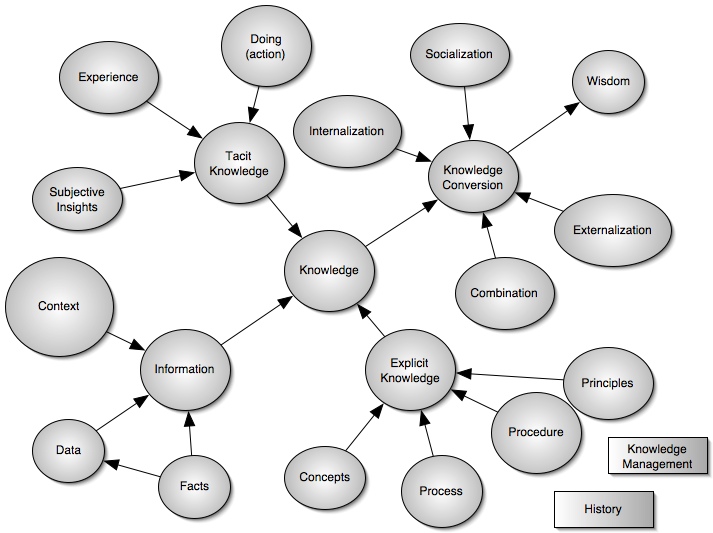
Knowledge itself comes in two forms:
Explicit
Tacit
- Explicit knowledge has been recorded and documented and can easily be shared with others. For example, an instructions manual for mobile phone.
- Tacit knowledge refers to knowledge that is learnt and cannot be easily shared with others. Tacit knowledge is problematic in a service organization because if it is not shared with others, it cannot be leveraged to solve problems and is gone when the knowledge holder leaves the organization. This type of knowledge can only be transferred during on the job training.

As individuals we have different knowledge about various things. These knowledge differences can be associated with the level of education, jobs we do, type of people we are and the life experience we’ve had.
Knowledge can be broadly defined, however the general definition of knowledge is information combined with experience, context, interpretation and reflection. Knowledge is a high-value form of information that is ready to be applied in a decision and/or action process.
Knowledge itself comes in two forms:
Explicit
Tacit
- Explicit knowledge has been recorded and documented and can easily be shared with others. For example, an instructions manual for mobile phone.
- Tacit knowledge refers to knowledge that is learnt and cannot be easily shared with others. Tacit knowledge is problematic in a service organization because if it is not shared with others, it cannot be leveraged to solve problems and is gone when the knowledge holder leaves the organization. This type of knowledge can only be transferred during on the job training.
(2)
In our case, knowledge within collaboration involves engaging people who do the work and empowering them to identify appropriate adjustments to the process. We all have different types of knowledge about different things; it’s a matter of collaborating the right way and bringing the best out of your team member through their strengths & support of the other team members. Each group member has to participate in a variety of processes to facilitate effective knowledge about the project. This process includes discussions about both minor and major matters. It all comes down to getting the right person do right job in order to complete the task successfully and in a timely manner.
Roles within knowledge collaboration flow through a chain of group members though communication from various perspectives. By identifying the key roles along this chain, people who play those roles, and their perspectives, helps to make this process flow smoother. Example from our group, V has great knowledge of 3D modelling within 3D max, where I have better knowledge of Revit. It’s just matter of combining these two programs and getting the best result at the end. The site of the building will be done in Revit & the model will be done in 3d max. This is just one of the examples from our group. The list will keep growing as we move ahead in our project. The one thing in which we are all at the same level is knowledge in UT3, we are all in the process of learning the new program. At the end of the day, identifying the knowledge of each team member plays a big role with successful completion of the project. (1)
References
(1) http://www.thinkhdi.com/hdi2006/files/StrategicAdvisoryBoardPaperKnowledgeCollaboration.pdf
(2) http://www.nwlink.com/~donclark/knowledge/knowledge_typology.jpg - image
Friday, April 11, 2008
Record
RECORD
Keeping accurate and up-to-date records is vital to the success of any business & teamwork. In our collaboration course the groups must realise that records kept will be one of the most important management tools it possesses and, therefore, it should be allocated due importance. Keeping records is a lot like score keeping - if you went to a football game where no one kept the score, you would have to ask “what was the point of that whole exercise?” By keeping the score you are able to work out who is performing better and who is winning.Any record keeping system should be accurate, reliable, easy to follow, consistent as to the basis used and simple.
Efficient record keeping is vital in regards to our group project. The commitments of each person must be kept as a record.
We need to record how we are achieving our goals?
What topic each person is currently working on?
What topic each person worked on during the week,
and the progress they have made?
What are our tasks?
Record of our face to face meetings with group members.
Record of online meetings among the group members.
Record of meetings with our tutor.
Record of the overall process.
Record of our references.
The above examples are some of the most obvious in successful record keeping. This list will expand as we progress more with our group project.
It isn’t a very exiting task, however it helps and shows the overall performance of the group. Good records keeping will contribute to the final result and a successful presentation. Mostly our records constitute emails & verbal conversations we held. Notes are always being taken by someone in the group when we are having meetings with the tutor & meetings between ourselves.
Each team member is given a responsibility and a timeline in which the task needs to be completed. Records enable us to keep a summary of decisions made, the reasons for those decisions and how we came to their resolutions. In the event of any problems of misunderstandings, they are an essential source of evidence.
Here is an example of record keeping:
Medical records are at the heart of good patient care and an essential component of understanding what went wrong and why. This is a powerful example of a record. If there was no medical record things would go out of control. Records make it a lot easier to discover patients’ problems through their medical history. This can play a major role in saving lives. (1)

Keeping accurate and up-to-date records is vital to the success of any business & teamwork. In our collaboration course the groups must realise that records kept will be one of the most important management tools it possesses and, therefore, it should be allocated due importance. Keeping records is a lot like score keeping - if you went to a football game where no one kept the score, you would have to ask “what was the point of that whole exercise?” By keeping the score you are able to work out who is performing better and who is winning.Any record keeping system should be accurate, reliable, easy to follow, consistent as to the basis used and simple.
Efficient record keeping is vital in regards to our group project. The commitments of each person must be kept as a record.
We need to record how we are achieving our goals?
What topic each person is currently working on?
What topic each person worked on during the week,
and the progress they have made?
What are our tasks?
Record of our face to face meetings with group members.
Record of online meetings among the group members.
Record of meetings with our tutor.
Record of the overall process.
Record of our references.
The above examples are some of the most obvious in successful record keeping. This list will expand as we progress more with our group project.
It isn’t a very exiting task, however it helps and shows the overall performance of the group. Good records keeping will contribute to the final result and a successful presentation. Mostly our records constitute emails & verbal conversations we held. Notes are always being taken by someone in the group when we are having meetings with the tutor & meetings between ourselves.
Each team member is given a responsibility and a timeline in which the task needs to be completed. Records enable us to keep a summary of decisions made, the reasons for those decisions and how we came to their resolutions. In the event of any problems of misunderstandings, they are an essential source of evidence.
Here is an example of record keeping:
Medical records are at the heart of good patient care and an essential component of understanding what went wrong and why. This is a powerful example of a record. If there was no medical record things would go out of control. Records make it a lot easier to discover patients’ problems through their medical history. This can play a major role in saving lives. (1)
Medical record keeping flowchart (2)
References: (1) http://www.hsj.co.uk/goodmanagement/record_keeping.html (2) http://www.hemidata.com/images/EMR-Diagram.gif

Tuesday, April 8, 2008
Week 4 - Discipline
Discipline
In the first week of our collaboration course we all as a class group had to drop down our skills. Each one of us presented our skills to the class. Most of us had similar skills, computer based skills. After this we were split into a group of 5 where we went into more depth of what our skills are. These skills included computer based, leadership, creativity..ect. Thought listening to each other we decided on our team Captain/Leader to be Simon Mollica. This was decided though his confident perception of tasks at hand & the skills he developed through his past leadership experiences in different fields. That was one of our first major decisions as a group.
In the most architectural firms looking from experience & talking to other group member the most important disciplines would have to be architectural knowledge (to produce well/clear presented drawing), engineering (Landscape, Electrical, Drainage) & construction.
To successfully produce the High court of Australia by Harry Seidler in its final form in UT3 we had to decide on our first major list of disciplines. This is just the start of the list as I am sure it will increase as we get more into our project. The disciplines that we have decided on are:
Texture mapping of building
Texture mapping interior/objects
Texture mapping of surrounding landscape
Video presentation
Modelling external
Modelling interior
Lighting
Animation
Building/surroundings research
Image manipulation (Photoshop)
Sound
After looking at our own strengths & weaknesses, though use of email we have decided what each one of us will do from the above list. Knowing that this is a group project & we will assist each other in whatever way needed to get the best result at the end.
The disciplines that I will take on in the major project are: Texture mapping of building & Texture mapping interior/objects.I came to this decision as I have done a lot of Texture mapping of building & Texture mapping interior/objects in the first semester of my Computer Architecture degree, though use of 3D studio max and other well supported programs like Photoshop. With the model that Vivian is in process of making, I will be applying my textures based upon images I found and created as it is my job to ensure that the building looks realistic. I will also go into more research of the Seidler’s buildings & see the similarities which we can use in our project. Matt has given us examples of few Seidler’s building within Sydney area which I plan to visit.
We are very lucky, with the technology on offer in present society & the use of collaboration amongst our group tasks. This will allow us to focus more on our task as there will be less need for face to face meetings. The meetings will be done though use of MSN, emails which is a great advantage to all of us.
In the first week of our collaboration course we all as a class group had to drop down our skills. Each one of us presented our skills to the class. Most of us had similar skills, computer based skills. After this we were split into a group of 5 where we went into more depth of what our skills are. These skills included computer based, leadership, creativity..ect. Thought listening to each other we decided on our team Captain/Leader to be Simon Mollica. This was decided though his confident perception of tasks at hand & the skills he developed through his past leadership experiences in different fields. That was one of our first major decisions as a group.
In the most architectural firms looking from experience & talking to other group member the most important disciplines would have to be architectural knowledge (to produce well/clear presented drawing), engineering (Landscape, Electrical, Drainage) & construction.
To successfully produce the High court of Australia by Harry Seidler in its final form in UT3 we had to decide on our first major list of disciplines. This is just the start of the list as I am sure it will increase as we get more into our project. The disciplines that we have decided on are:
Texture mapping of building
Texture mapping interior/objects
Texture mapping of surrounding landscape
Video presentation
Modelling external
Modelling interior
Lighting
Animation
Building/surroundings research
Image manipulation (Photoshop)
Sound
After looking at our own strengths & weaknesses, though use of email we have decided what each one of us will do from the above list. Knowing that this is a group project & we will assist each other in whatever way needed to get the best result at the end.
The disciplines that I will take on in the major project are: Texture mapping of building & Texture mapping interior/objects.I came to this decision as I have done a lot of Texture mapping of building & Texture mapping interior/objects in the first semester of my Computer Architecture degree, though use of 3D studio max and other well supported programs like Photoshop. With the model that Vivian is in process of making, I will be applying my textures based upon images I found and created as it is my job to ensure that the building looks realistic. I will also go into more research of the Seidler’s buildings & see the similarities which we can use in our project. Matt has given us examples of few Seidler’s building within Sydney area which I plan to visit.
We are very lucky, with the technology on offer in present society & the use of collaboration amongst our group tasks. This will allow us to focus more on our task as there will be less need for face to face meetings. The meetings will be done though use of MSN, emails which is a great advantage to all of us.
Tuesday, April 1, 2008
Week 2
A. Synchronous Messaging, SKYPE; MSN; TEAMSPEAK;ICQ
There is a lot of ways in which to communicate to people specially with today’s new programs, new technology, other then face to face the communication is mostly done through synchronous messaging. There are a lot of programs out there that allow us to communicate much easier through there different offerings. The communication through synchronous messaging could be used for personal things, business & students, that’s where teamwork & collaboration of teams becomes a bit easier. The programs that I will be looking at closely are ; SKYPE; MSN; TEAMSPEAK;ICQ & others like Google talk. Each one of these have different strengths & advantages when it comes to collaboration + teamwork environment.
There is a lot of ways in which to communicate to people specially with today’s new programs, new technology, other then face to face the communication is mostly done through synchronous messaging. There are a lot of programs out there that allow us to communicate much easier through there different offerings. The communication through synchronous messaging could be used for personal things, business & students, that’s where teamwork & collaboration of teams becomes a bit easier. The programs that I will be looking at closely are ; SKYPE; MSN; TEAMSPEAK;ICQ & others like Google talk. Each one of these have different strengths & advantages when it comes to collaboration + teamwork environment.
Synchronous Messaging “Business Use/Teamwork collaboration ”
Now that there a lot of options on online meetings and internet conferences available. People need to decide on which one will give them best options as we need to decide in our mission to successfully completing this group fabrication project. There are a lot of advantages of conducting online meetings over the setting up of more traditional face to face meetings. First, the expense of face-to-face meetings can be costly, particularly when people are travelling great distances to meet together regularly. Another advantage to having online meetings as opposed to face-to-face meetings is the ability to conduct the meeting from whatever location you may be in. If you are working from home, for example, using the internet and conference software allows you to instantly connect with other members of your team, giving you more time to spend on successfully completing your task, as there is no face to face meeting needed . All this has become a bit easy through use of different programs. E.g. SKYPE; MSN; TEAMSPEAK;ICQ. (1)
· MSN
 MSN is a quick way of communicating with people and it is easy to use. It is usefully in many ways like keeping in touch with you family’s, friends and also collaboration of teamwork as in this case we will use it a lot in the upcoming project.The advantages of msn is its a great tool to have when communicating about your school work, you can ask your friends if you don’t understand what needs to be done. MSN makes this easy as people don’t have to go out and meet there peers, it allows them more time to spend on completing there task. A lot of businesses use it as a easy way of communication. Meetings can be arranged easily through voice conferencing or even synchronous massaging. MSN messenger so called “Windows Live Messenger Mobile” this can be used with most mobile phones which makes it a little easy if you don’t have a computer next to you. It works same as a PC Messenger. The new MSN version have introduce the offline messaging, where you can send a message to your team members who are offline. They will receive the message once they come online. Other advantages of MSN is people can share folders, images, files. This is going to come in handy as our group will be communicating mostly over msn, the transformation of data becomes quick and easy. Looking at all the example/facts, Overall MSN plays a major role in team working environment though the above examples. (2)
· SKYPE
 Skype is a popular program. It is different to msn. People mostly use Skype for phone class where they use msn for chats. A lot of businesses use Skype as it gives small businesses the market advantage against larger competitors by operating on lower costs and increasing productivity with voice calls. It has similar advantages as msn messenger like group chat, file transfer. Other options that it offers better then msn is instant conference calling, free toll-free calling. A lot of businesses use Skype as a easy way of communication with there employee in other firms where msn is mostly used for personal thing, group project within the school/uni environment.(3,4)
SKYPE or MSN “Which one do people prefer”
After talking to a few friends and peers from work. It is obvious what they use for different things. Video/Voice conversations are better to use in Skype as its more quicker. The Architectural firms that I work in uses Skype as a second way of transferring data, the first way is email. If the size is to big they use Skype. MSN is mostly used for chats where Skype is used more in the work environment. They both have there advantages, text messaging would be better with MSN where video conversation better with Skype. Most of the people that I have talked to say “MSN is good for chat”, “Skype is very good conversation”. Looking at both of these example’s in a team working environment they would both come in handy. It would save us a lot of time.
· ICQ
 ICQ is another effective way of communication. It is very similar to the above example. It is used often in team working environment. ICQ has more features and allows more flexibility which are very similar to the MSN & Skype. One of the great advantages of ICQ is its chat feature that allows you to set up a invite-only chat on the internet. ICQ uses minimum amount of bandwidth and system resources. Other advantages that it has on offer are similar to the MSN. (6,7,8)
· TEAMSPEAK

Team Speak is different to the above examples of synchronous messaging, it is an application which allows its users to talk to each other over the internet. It was designed to be run in background of the online games. The voice quality is fairly good as good as normal phone calls. It is know as one of the best online gaming communications. One of the biggest advantages of TeamSpeak is that it is cross-platform voice communication tool, which means that the client and server are available for Window. It does not matter which operation system you use it is design so it works well across the board. This particular example of synchronous messaging is new to me, looking forward to knowing more about it if we come across it in our group project. (5)
· GOOGLE TALK
 Google talk is another good way of communication. This is a new program which is still in the process of becoming better. It has similar advantages to Skype. Skype is actually much more versatile, especially considering that it allows users to make outbound calls to conventional telephones (for a small fee). Google Talk, on the other hand doesn’t support PC-to-Phone calls. This is just another synchronous messaging example which could be used in the team working environment. (9)
In conclusion, closely looking at all these example, they are all similar in a lot of ways. They all offer similar advantages which we can take into consideration when doing our group projects. We are very lucky to have all these on offer as it will save us a lot of running around and meeting with people. Synchronous messaging will allow us to concentrate more on the task at hand other then meeting face to face.
1. http://www.allconferenceservices.com/online-meeting.html
2. http://en.wikipedia.org/wiki/Windows_Live_Messenger
3. http://www.fool.com/investing/general/2006/01/03/skypes-advantage-cannot-be-
4. http://about.skype.com/2005/10/skype_gives_small_businesses_m.html
5. http://www.opensource-it.com/-TeamSpeak-.html
6. http://www.smashingmagazine.com/images/shortcuts/icq-logo.jpg

7. http://www.ciao.co.uk/Reviews/icq_com__75462
8. http://en.allexperts.com/q/ICQ-1433/ICQ-Pro2003b-font-color-1.htm
9. http://www.teleclick.ca/2005/08/google-talk-lacks-competitive-advantage/
Wednesday, March 19, 2008
Another Example
 Hey Guys,
Here is another example of a interesting building I came up across in the FuturArc Magazine. Its expected to be build in 2009. Check it out, let me know what yous thing.


Sunday, March 16, 2008
Week 1
 Australian Architecture has an important tradition of the Unbuilt Projects Awards. Projects that are unbuilt, and sometimes unbuildable but nevertheless some make a significant contribution to the development of the discipline. Think of many projections of idea cities over the centuries and the architectural entries into important competition. They all play a big part on our architecture as there is one design that wins it at the end. Different entries give people different ideas.
Above shown: Swetik Korzeniewski’s competition entry, “a powerful response to the egalitarian mood of the 70s”. National Archives of Australia. (1)
The building that I have choose is a competition entry of the Unbuilt Australia competition “New Parliament House” designed by a well known architect Swetik Korzeniewski . The reason that I have choose this particulate design is because it is unique in a lot of ways & it also would of been a very important part of Australia’s parliament history if it was built in our National Capital. “The projected monstrated a clarity of expression and powerful response to the egalitarian mood of the 70s.” (1) This being a Parliament House, with its 70’s detail look it would be interesting & a great challenge in doing an model for this project and also doing a virtual Environment in UT3.

The building has a 70’s look as show thought its details on the model. The baroque-inspired forecourt enclosed by this colonnade was open to the public it also contained the houses of the parliament and the public galleries. (1)Looking at the model there is a lot of interesting ideas & the way the project has been designed. In the model presented there is a lot of detail involved in modelling this project specially without much information as I was not able to find any more info on it.
The building looks like a huge project with a lot of detail involved in it. For our group Fabrication Assignment, looking at this project it would defiantly be a huge task in completing it successfully in time. On the other hand we could pick out a section and go into more detail with it, without doing the whole lot as we are not sure on how big of a project we need to do in UT3. I like the design, it is different. It is in shape of a football stadium which makes it unique. My main skill being 3D modelling in Revit and 3D Max, I think I can put together a nice presentation with the ideas and help of my piers. All the other aspects that need to be done in the process of completing this project we can collaborate together as a group and decide on what each persons strengths are & then delicate tasks.
Subscribe to:
Posts (Atom)